
Caral:
The Journey to the Dawn of Civilization
Caral is often associated with the origin of civilization in the Americas. However, beyond this emblematic site lies a broader territory that continues to reveal new discoveries, advances in conservation, and evolving ways of interpreting its legacy.
This chronicle journeys through fertile valleys, archaeological sites, and recently opened spaces that broaden our understanding of this ancient culture—now more accessible and better understood—along Lima’s northern coast.
Join Palmira on a journey that explores the enduring relevance and evolution of the oldest civilization on the continent.
Caral and its cultural network
Who hasn’t heard of Caral—the oldest city on the continent, with more than 5,000 years of history? Recognized by UNESCO as a World Heritage Site in 2009, recent discoveries have revealed that its significance is even greater than once believed. Dozens of active settlements have been found in its surroundings, suggesting that we may be looking at a vast cultural network that transformed this coastline into the true cradle of Andean civilization.
But beyond Caral itself, the entire region is filled with vestiges that tell a fascinating story spanning millennia. Sites such as Bandurria, Vichama, and Peñico—active before, during, or after Caral’s height—reveal the breadth of an impressive cultural network that once flourished along the northern coast of Lima.
Depending on the guest’s time and interests, countless combinations can be designed to explore this ancient region. In our case, we were fortunate to dedicate two full days to history, unforgettable photographs, delicious food, and, of course, wonderful company.
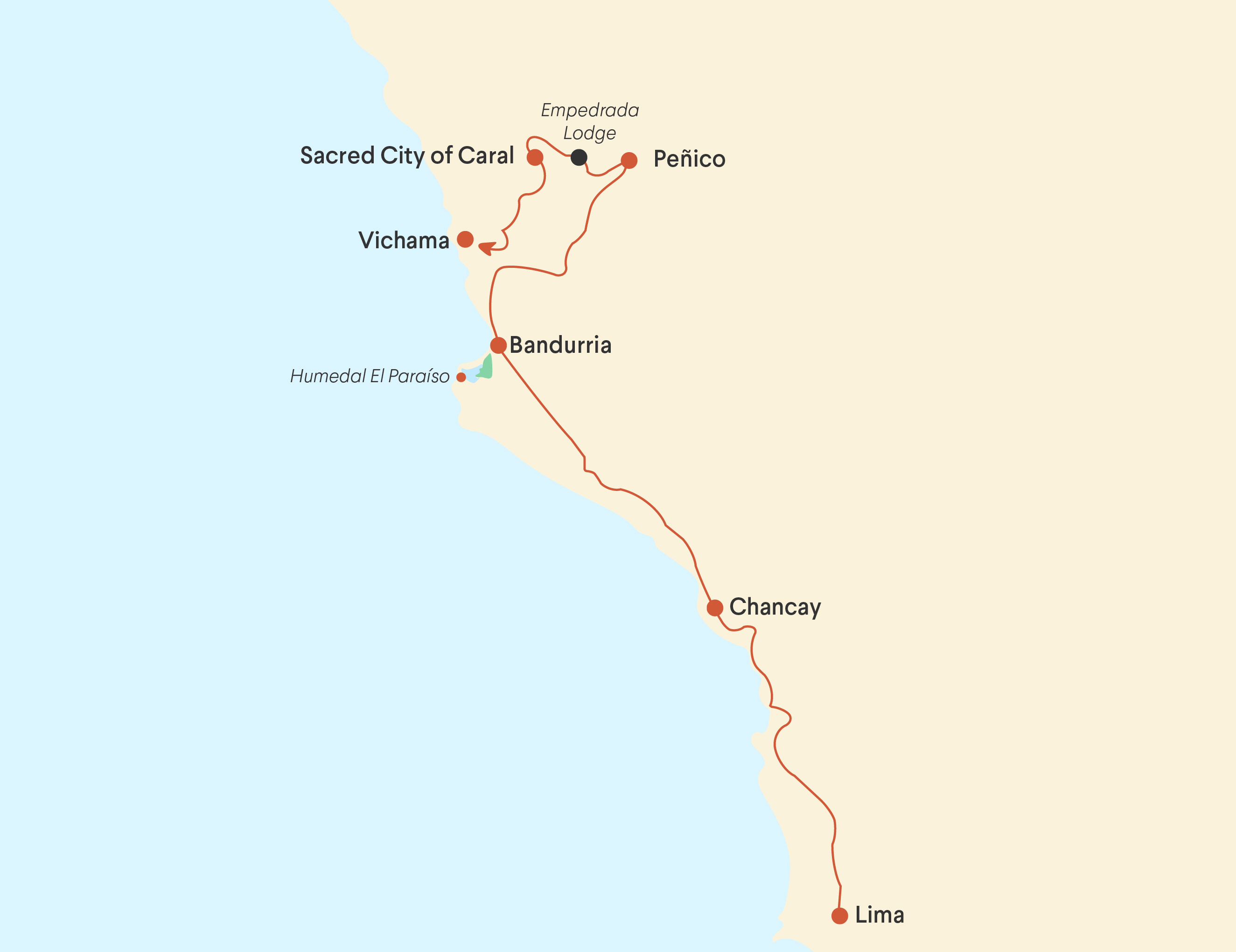

Beginning the journey
Our journey began early, following the coastline northward. Our first stop was the city of Chancay, which welcomed us with the aroma of a classic pan con chicharrón and a steaming cup of coffee. From above, we could take in the view of the impressive new Port of Chancay—considered the most modern in South America and already a key hub for trade with Asia.


Bandurria: Archaeology beside a wetland
Just 30 minutes farther north, we arrived at Bandurria—one of the oldest archaeological sites on the coast and a contemporary of Caral. It was discovered by chance in 1973, when flooding from an irrigation system unearthed funerary remains and other vestiges.
What captivated us most about Bandurria was its setting: here, millennia-old pyramids stand beside the landscapes of the El Paraíso wetland, a refuge for dozens of endemic and migratory birds such as herons, coots, flamingos, gulls, and, of course, the iconic bandurrias. It is also an essential stop for birdwatching lovers. In this extraordinary place, history and nature come together to offer a truly unparalleled experience.
Lunch was at the iconic Tato Restaurant in Barranca. Its famous tacu tacu—crispy on the outside and creamy on the inside—was the star of the meal, accompanied by fresh seafood dishes and a soothing view of the sea.


Peñico: A recent discovery
With renewed energy, we arrived in Peñico. For centuries it remained buried beneath the sand until, in July 2025, archaeologist Ruth Shady officially announced its discovery. The news made headlines around the world.
Around 1000 B.C., Peñico was considered as significant as Caral. Its roughly 18 structures include temples and ceremonial plazas, as well as residential areas. What is most striking here is what the architecture reveals: the Caral–Supe civilization was able to confront natural disasters through knowledge and technological development, as well as through a harmonious relationship with their environment. All of this enabled them to build a complex society founded on cooperation and respect for nature, rather than military conflict.
“Peñico confirms that millennia ago there existed a civilization here that chose knowledge and cooperation over war and conflict.”
The day ended with a sunset that set the sky ablaze in shades of red, orange, and yellow. We were welcomed by Empedrada Lodge, a charming hacienda managed by Casa Andina, where we enjoyed a restorative night’s rest…


Caral: Back to the origin
The following morning, after a breakfast of freshly baked rolls, avocado, and olives, we set out for the archaeological complex of Caral. Just 30 minutes away, we finally stood before its impressive ensemble of seven main pyramids.
It is estimated that the Caral civilization reached its peak between 3,000 and 1,800 B.C. Although they did not use ceramics or weapons, its people mastered urban planning and built remarkable monumental complexes. Among their constructions, the stepped pyramids paired with sunken circular plazas stand out—spaces believed to have hosted gatherings, ceremonies, and ritual concerts that reinforced their spiritual connection to the earth. Notably, due to their sophisticated design, these plazas offered remarkable acoustics.
On this point, it is also known that Caral’s inhabitants had a special connection with music. Evidence of this includes the bone flutes and horns found at the site. Alongside their musical practices, they made important advancements in agriculture, fishing, astronomy, and architecture.
Among the most fascinating aspects of their architectural development are their advanced anti-seismic construction techniques. In an area prone to frequent earthquakes, Caral remained standing thanks to the use of shicras—large bags woven from plant fibers and filled with stones, which served as flexible foundations capable of absorbing seismic energy. This system, unprecedented in the ancient world, continues to amaze even modern architects.


Vichama: Reliefs that tell a story
We then continued toward our final stop, Vichama, located in Huaura, very close to the Pacific Ocean. This site—over 3,800 years old—captivated us from the very first moment with its clay reliefs, unique in the entire region. The human figures, fertility symbols, ritual scenes, and sacred animals depicted here are so well preserved that they seem as if they might step out of the walls at any moment. We were accompanied by the archaeologist in charge of the site, who shared interpretations of the reliefs: periods of drought, climatic changes, and the resilience of a society that faced adversity by creating art and memory.
Amid pyramids, plazas, and staircases that bear the unmistakable imprint of Caral–Supe, the reliefs of Vichama offer us an intimate glimpse into the myths, fears, and hopes of a civilization that, even today, continues to speak to us.


Closing the Journey
Every part of this experience was extraordinary: clear signage, rest areas, picnic spaces, and clean facilities that offer comfort and peace of mind to visitors. But above all, what truly stands out are the passionate guides and archaeologists—local scholars who share their knowledge with contagious pride.
We returned home in awe, feeling an even deeper admiration for our country. With simple logistics and a perfect blend of history, nature, and gastronomy, this still little-known destination offers an authentic and profoundly enriching experience for every type of traveler. Because Caral and the sites that surround it do more than recount the origins of a civilization—they do so with a monumental force that continues to inspire wonder thousands of years later.
Discover the wonders Peru has to offer your travelers. Contact our destination experts.